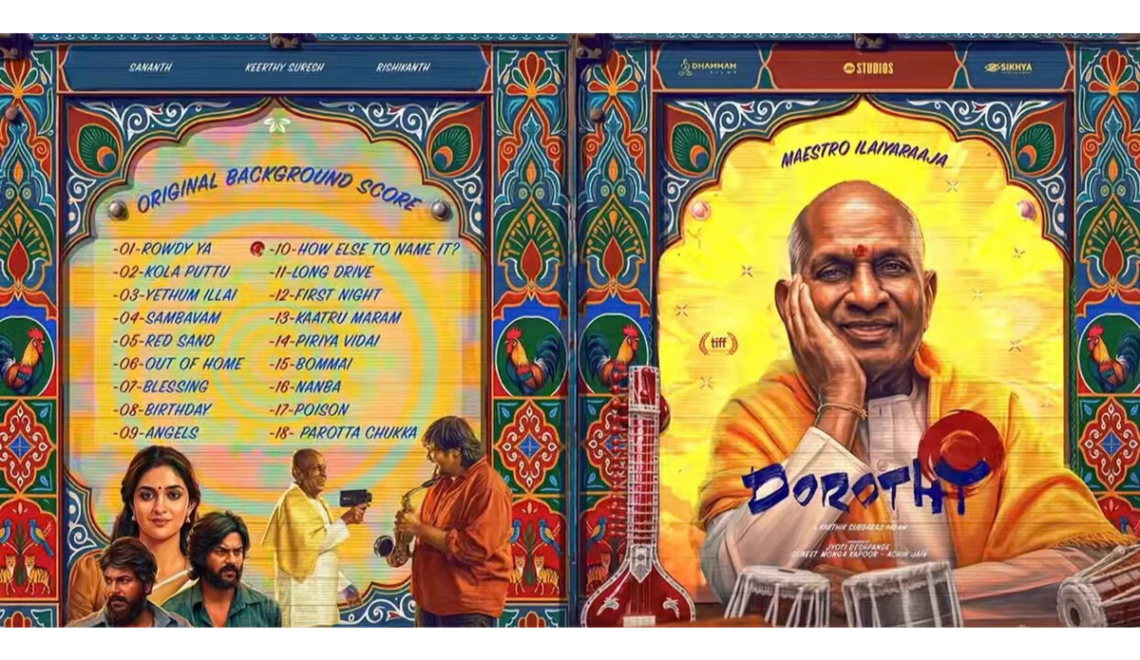
Dorothy Movie Review: An extraordinary Ilaiyaraja elevates this deeply empathetic Karthik Subbaraj film
Early in the movie, just before the now-viral Kalyana Virundhu hits, there is a nadaswaram that goes off to celebrate the newlyweds. But look at the music that Raja uses there — it is the theme from Star Wars, a beautiful Easter egg for “my dear John Williams,” as Raja likes to call him. It is a blink-and-you-miss-it feature that lasts no more than 10 seconds, but it is the kind of naughtiness expected from the man who deserves the title of BGM king. It is the first of five Rajas you meet in the film. This phase is called Naughty/Mischeivous Raja as the maestro plays with that emotion for much of the first act, roughly 40 minutes, as kids and adolescents are forced to conform to the rigid societal and behavioural contours of 80s and 90s Tamil Nadu.
As the film barrels its way to its interval, we are introduced to the second Raja. The Teacher. Raja steps in this time with a hat-tip to another musician he highly rates, one whom his director Karthik Subbaraj adores — the late, great Ennio Morricone. But Raja does not pay homage to this segment like he does the Williams one. Instead, he teaches you how to adapt a sound you love to the milieu you are working with. The violin first enters, then the cellos, then the operatic choir. On the red sands (the name of the music piece also is just that) of Madurai, featuring just three people fighting, the camera literally arrives before the people arrive and Raja bookends them. The same visual keeps repeating multiple times — left to right, right to left, top to bottom and bottom to top.
Then comes the second half, and Raja makes you understand that the boys you saw first are no longer naughty; they are no longer fighting external battles. A small tunnel that people use to cross from one village to another has a metre-gauge railway running over it. As a figure slowly walks into the screen, across the grassy knoll next to this elevated rail track, ready to enter this narrow tunnel, silence fills the screen. And then the sudden sound of a train whooshes past, jolting everyone off their seats. A beat passes. The train sound is off into the distance but not fully gone. And this figure slows down, stops for a second, watching as the camera frames a solitary figure in the darkness of the tunnel. Pure horror trope. Another beat passes before the sound of the distant train merges with the slow-rising cry of sadness, a cry of anguish, by the woman looking at the figure. That knowledge of when to make that silence stay before kickstarting his music is all Raja. The Teacher Raja gives way to showcase Horror Raja.
Dorothy is Karthik Subbaraj’s take on gender and is a companion piece to his last film on this topic, Iraivi. While Iraivi was an aggressive take on toxic masculinity, Dorothy is his slightly less angry and way more compassionate take on what it means to be a man in the first place. The decade has probably mellowed down Karthik a bit. You can see it in his scenes. They last and linger a beat longer than they usually do. The title card comes on screen at the end of the first act, but that almost meditative patience is present in the third act too, defying traditional screenwriting rules.
That does not mean that the film is laborious. It is anything but. The film moves quickly at times, before you are even ready for it, and yet when the typical Karthik Subbaraj twists come, you are still invested in why the characters behave the way they do.
Which brings me to the characters that populate this world. While the story moves primarily through Karthik (Rishikanth) and Subbu (Sananth), it is the world around them that influences them to become who they are. Be it Karthik’s mother and other women of the movie who influence Subbu or Subbu’s father and the other men of the movie who influence Karthik, this is almost the director taking the quite famous “which wolf you feed” quote and filming it out. It is also a long argument of nature versus nurture, but not in the traditional sense that you associate with cinema.
As the characters populating this 1996 world escape or try to escape this horror setting of theirs, there is a mirror being held to the humanity around them. And this is where Humane Raja enters the scene. Not once but twice, Raja reaches back into his own wonderful 1980s album, How to Name It for the eponymous piece titled How to Name it. Think about that title for a second. A film about feelings the world around these boys has no words for, scored with a tune called How to Name It. And look out for when it plays on screen.
The film draws on the idea, found in Hindu philosophical traditions and iconography, that masculine and feminine principles need not be understood as completely separate or opposed. Through the film’s eponymous character Dorothy (Keerthy Suresh), whose real name we never know in the film, the director asks: if these different aspects can coexist within us, why do we fight to have only one part constantly showcase itself? Why do we fight to suppress the other aspect?
Karthik Subbaraj literally splits his name out into his two characters, and he keeps asking through the dialogues and actions by and to Karthik and Subbu: what will it take for you to be a true man?
Till about the last 15 minutes, this film is an extraordinary friendship story. What does it take for you to accept your friend for what they are? Do you want them to be the way that you saw them at a different stage in your life? Do you want to control aspects of their life that do not conform to how you see them or how you think they should be seen? Or can you accept that friend for what they truly are at every point in the life that you have been a part of?
Now, why did I stop with the last fifteen minutes? Because the story moves from allyship to love, as Karthik alludes to at the start and end of the film, and this is where the film does not earn its presence through the story it has told so far of two separate characters.
But Raja looks at these 15 minutes in a different way. And thus the maestro ascends from the humane to the Divine Raja.
This 83-year-old genius looks at it and sees that it is beyond human understanding, that it is divine, that it has been divine for millennia, and maybe that is a lens for you to use if you can’t accept it immediately. That is why I call this a compassionate film.
A younger Karthik would have used the same dialogues he has used in this film to hit you with a hammer on the head. But this Karthik, wizened, with plenty of grey hairs now, takes you by the hand, alongside Raja, and asks you: how far can you travel with me?
How many questions can you ask of the man that you are today, the man that you were yesterday, and the men that will be around you in the future, when you leave this cinema hall, to make an inclusive, empathetic, kind, accepting world?
